UNSEPERATE STORIES | Institutional Conditioning Part IV: Concentrated Control
Control does not eliminate questioning. It limits its effect. This article examines how structures narrow influence over time without appearing to do so.
UNSEPARATE STORIES
by Scribe Diva Ink
5/26/20262 min read
Unseparate Stories | Institutional Conditioning
Part IV: Concentrated Control
by Scribe Diva Ink
There are conditions in which questioning does not disappear. It becomes constrained. What can be asked narrows. What informs those questions narrows further. Dissent remains, but its capacity to influence diminishes.
Authority does not need silence to limit effect. Questions can be raised, but not all carry forward. Concerns can be voiced, but not all reach those positioned to act. The system does not respond to input equally.
Over time, the boundaries become understood without being stated. What the structure supports is repeated. What is not begins to fall away. Participation adjusts accordingly. Not because awareness is absent, but because the conditions for sustained challenge are reduced.
Administration of Circulation
History reflects this pattern clearly. In the Soviet Union, expression remains within defined limits. Information moves through approved channels. What fell outside of those channels did not circulate.
Questioning did not disappear. It lost reach.
During the McCarthy era in the United States, the cost of association narrowed what could be expressed publicly. Compliance did not require agreement. It required preservation.
Managed Visibility
The same structure appears in modern systems. In large organizations, concerns move through layers that refine and contain what is carried forward, often altering what arrives. The process continues, but outcomes do not always change.
In digital environments, visibility is shaped by ranking, moderation, and distribution. Expression remains, but reach is uneven. What is seen becomes what is sustained.
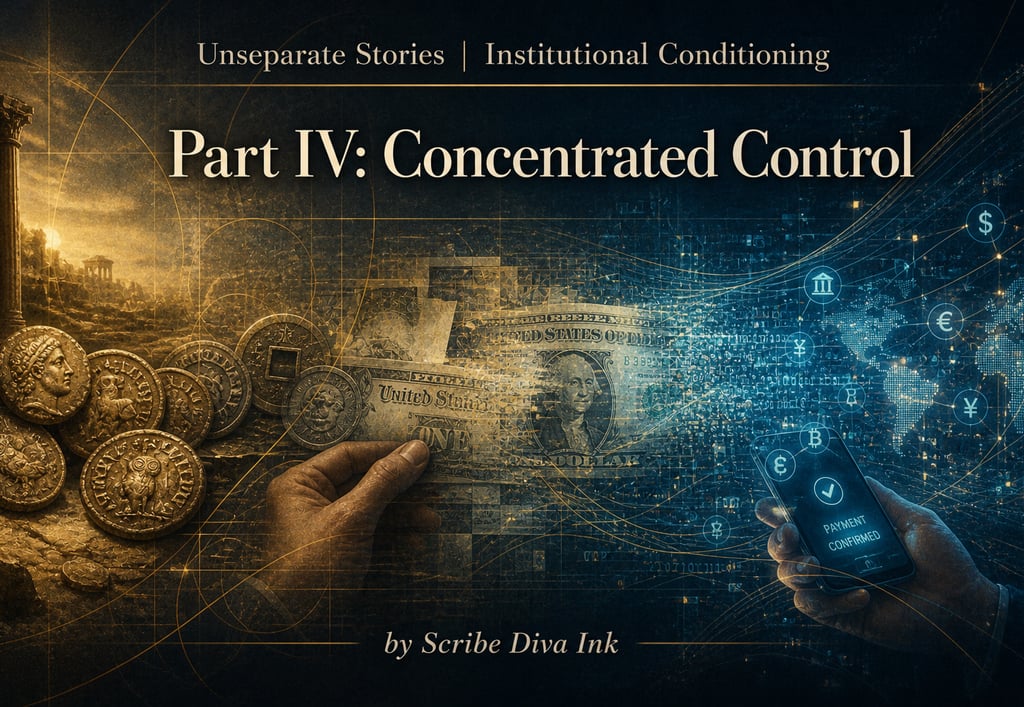
Money reflects this same pattern. It has taken many forms, from the drachma to gold and silver, to paper and coin, to digital records and cryptocurrency. Exchange continues, though not always by preference. Over time, conditions shift until participation becomes necessary. The system does not prevent transaction. It determines what that transaction allows.
Housing follows a similar structure. It does not disappear, but becomes organized through zoning, development constraints, and cost. People continue to live, but not everywhere they once could, and not under conditions they determine.
Water remains essential and present, yet access is not equal. It is stored, treated, distributed, and priced through systems that determine availability. People continue to consume it, but within conditions they do not control.
Over time, structures are maintained through continuity rather than response. Authority becomes less exposed to interruption, and accountability diminishes accordingly. Those responsible for enforcement operate within defined limits. The structure does not prevent input. It determines what is prioritized, if any of it is prioritized at all.
This is how concentrated control forms: through accumulation. Small limits are placed on effect, adjusted in increments, and repeated over time. With each cycle, adjustment becomes easier and less contested. Eventually, structures align. What remains is a system in which expression exists, but influence is uneven.
The Underlying Mechanism
Concentrated control rarely depends on eliminating participation entirely. It is reinforced through narrowed influence, managed visibility, and unequal capacity to affect outcomes.
Who determines what reaches public attention?
Who controls the channels through which information moves?
What forms of participation retain influence?
When does expression remain visible while impact quietly diminishes?
In metaphor, it is not only whether people are allowed to speak. It is:
whose voices continue to travel,
whose concerns lose reach before they gain traction,
who remains visible within the structure,
and who is permitted to participate without meaningfully altering outcomes.
These conditions persist not always through overt suppression, but through systems that narrow influence gradually over time. Visibility becomes managed. Managed visibility shapes participation. Participation continues, even as its capacity to interrupt weakens.
This is how concentrated control sustains itself. Questions remain possible. Expression remains present. Systems continue to receive input. Yet over time, the range of outcomes narrows while the appearance of participation remains intact.
Still, what remains does not complete itself. It requires participation.

info@cjmarieholdings.com
© 2025 CJMarie Holdings, LLC. All rights reserved.
Join Us
Stay connected with insights and updates