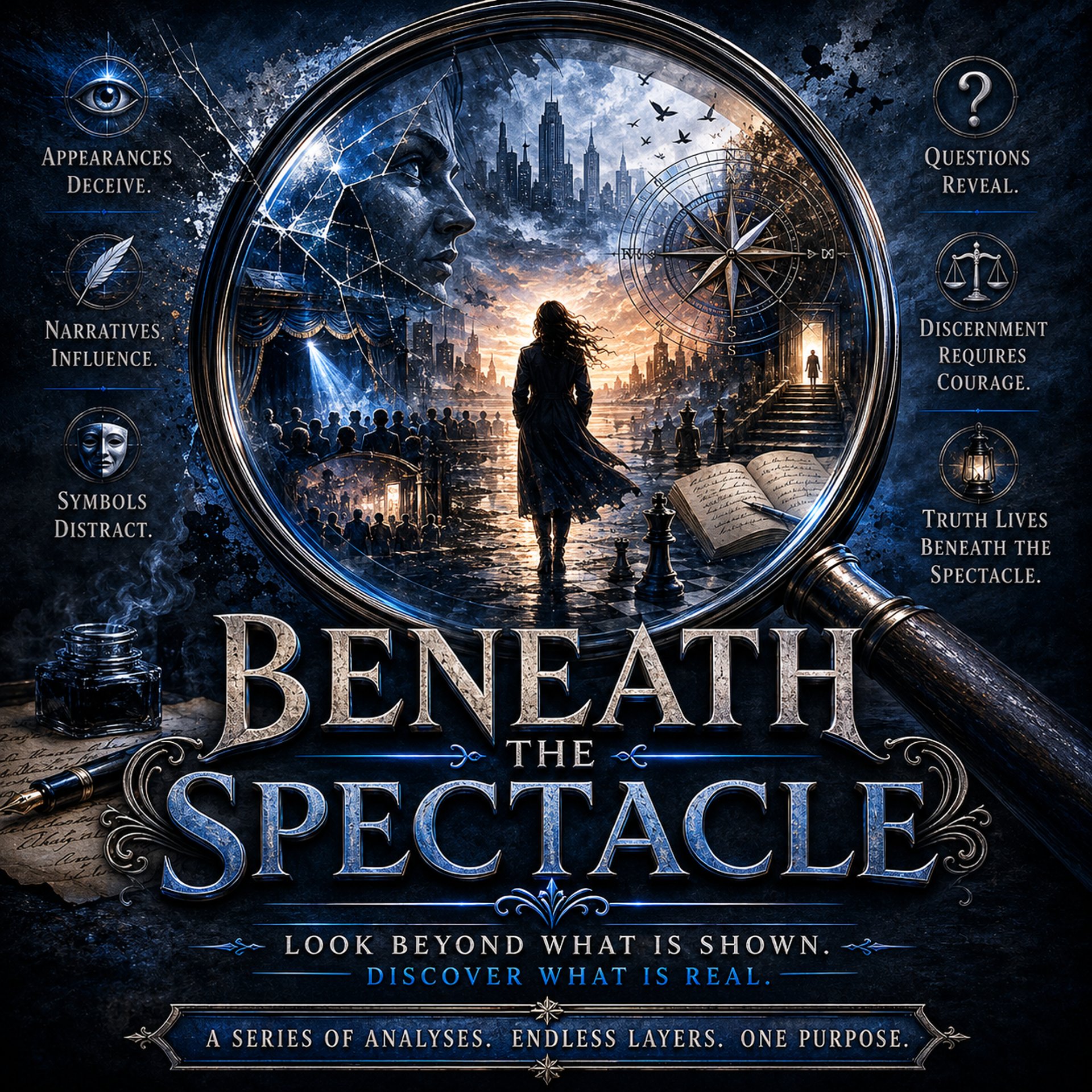
BENEATH THE SPECTACLE
by Scribe Diva Ink
“All spectacles reveal. Some revelations hit harder than others.”
I have always been drawn to complicated stories. Not simply stories with twists, spectacle, or grand visuals, but stories that continue unfolding long after they end. Stories where the antagonist is understandable. Stories where morality destabilizes. Stories where identity fractures under pressure. Stories where the supposed villain sometimes wins and should. Stories that refuse simple emotional conclusions.
For years, I did not fully understand why certain films stayed with me. Some movies disappeared after the credits rolled. Others lingered for years. I would revisit scenes mentally, replay dialogue, rethink symbolism, and feel compelled to watch them again. Not because I was trying to “solve” the story, but because something beneath the visible narrative continued speaking. Certain stories felt larger than entertainment. They felt revealing.
I now realize that what stayed with me was not simply the plot itself, but the hidden patterns, tensions, warnings, truths, and revelations beneath it.
Introducing Beneath the Spectacle.
This series explores how stories, symbolism, culture, and public narratives reveal deeper truths beneath life experiences and entertainment itself. This exploration began with Unseparate Stories and continues with Sinners, the first installment of Beneath the Spectacle. Narratives exist everywhere: films (including documentaries), television, books (fiction and nonfiction), music, institutions, cultural moments, and current events. Human beings unconsciously reveal themselves through the stories they tell, create, repeat, celebrate, defend, fear, and consume.
Action, fantasy, horror, dystopia, science fiction, vampires, ghosts, revolutions, monsters, kingdoms, and apocalyptic worlds often function as the visible layer. Beneath them are deeper revelations involving power, religion, identity, freedom, fear, belonging, survival, memory, and selfhood. The spectacle attracts attention, but the underlying truths sustain meaning. This is why certain stories remain culturally alive long after release. Not because they are merely entertaining, but because they expose something recognizable beneath the fiction. Something unresolved. Something recurring. Something human.
Stories are mirrors. Not always literal mirrors but symbolic ones. A horror film may reveal fear of transformation or the inability to release grief. A dystopian story may reveal how systems sustain control through spectacle, scarcity, or performance. A fantasy epic may reveal how power reshapes morality. A psychological thriller may reveal how fragile identity and perception truly are. Even stories centered around monsters often reveal profoundly human truths. Sometimes the monster is fear. Sometimes loneliness. Sometimes desire. Sometimes surrender. Sometimes power. Sometimes the refusal to confront reality.
The most powerful stories rarely provide simple answers. Instead, they expose uncomfortable truths. That is what interests me. Not criticism for criticism’s sake. Not reducing stories into rigid “correct interpretations.” Not proving intellectual superiority through analysis. What interests me is what is revealed beneath what is visualized. The unspoken. The indirect message. The covert conditioning. Illusions we surrender to.
Perhaps that is why certain encounters stay with us. Not because they answer our questions, but because something beneath speaks long after the story ends.