UNSEPERATE STORIES | Institutional Conditioning
Control does not require force to persist. It requires participation. This section examines how what continues becomes what sustains.
UNSEPARATE STORIES
by Scribe Diva Ink
6/1/20263 min read
UNSEPERATE STORIES | Institutional Conditioning
Part V: Internal Undoing
by Scribe Diva Ink
There are conditions that do not require force. They require participation.
We have already established that we are in the same boat. Not because our experiences are identical, but because the structure carrying us is shared. The movement of that structure does not depend on agreement. It requires that what is already in motion is not interrupted.
This is not a question of blame. Systems shape conditions, and those conditions influence patterns. What sustains them is what continues. Control does not require permission.
Alignment does not occur all at once. It develops over time. What begins as access becomes convenience. Convenience becomes routine. Over time, routine no longer requires active decision. It carries forward by default. The structure does not need to enforce responses. It only needs to make certain actions easier, more accessible, and consistently repeated.
Participation rarely feels like a single decision. It forms through repetition. What begins as preference becomes habit, then expectation, then default. Over time, behavior no longer requires active agreement. It continues because it feels natural. What feels natural is rarely questioned.
The Reinforcement of Routine
Within these environments, awareness can increase without interruption. Information becomes available. Risks are identified. Alternatives are discussed. Signals are present. Yet established patterns persist. What is known does not interrupt what is practiced.
This is not because alternatives disappear, but because they become less practiced, less visible, and less reinforced. Over time, the path of least resistance becomes the path most taken. What is repeated becomes familiar. What is familiar becomes standard. What becomes standard is rarely questioned.
The pattern persists alongside this shift. Not always unconsciously, and not always without question, but consistently enough to sustain the structure itself.
Smoking was once routine, then restricted, then studied, then publicly linked to long-term harm. Warnings were introduced. Information became widespread. Awareness increased. Yet the behavior continues. Not because the risk is unknown, but because continuation has already been reinforced.
Food systems expanded from direct preparation to large-scale distribution. Over time, processing increased, options multiplied, and information became more available. Preferences shifted. Quality concerns emerged, yet engagement continues. Not because alternatives are absent, but because the structure already defined the pattern.
Driving expanded from limited use to daily necessity. Speed increased. Risk became measurable, visible, and widely understood. Safety systems were introduced, refined, and reinforced. Awareness remains constant. Yet the activity continues. Not because risk is unknown, but because it has been incorporated into routine.
Across each example, the pattern holds. Awareness does not necessarily interrupt behavior. Alternatives do not guarantee change. What continues is what sustains.
When Participation Sustains Structure
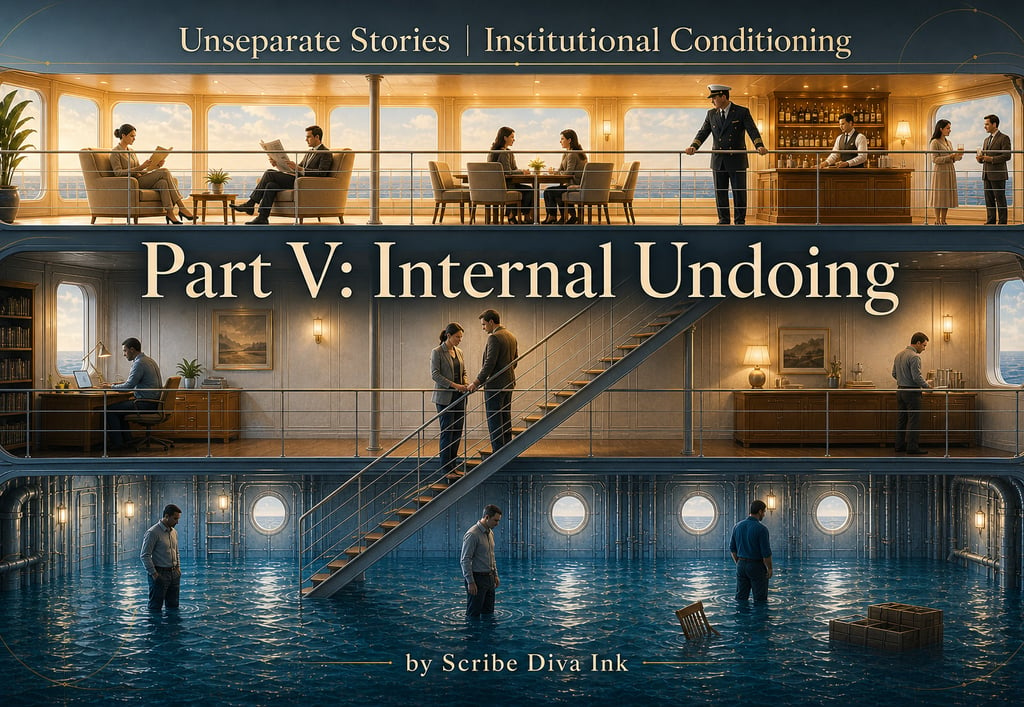
Now return to the boat.
The announcements have been made. The signals have sounded. Some hear them early. Some recognize them later. Some feel the shift beneath their feet. Others do not. Some are positioned where the water reaches first. Others are not yet.
But the movement of the boat does not pause.
Those below deck are not separate from those above. They are simply affected sooner. The water does not belong to one section. It spreads.
Some respond immediately. Some wait. Some question. Some continue as before. Not always out of denial. Not always out of ignorance. Often because continuation has already been encouraged and established.
This is where the pattern completes. This is the tension.
Participation continues, while responsibility is reassigned. Questions are raised. Systems are challenged. Yet the underlying patterns often remain unchanged.
The structure does not complete itself. It is completed through what continues.
The Underlying Mechanism
Internal undoing rarely depends on ignorance alone. It is reinforced through repetition, participation, convenience, and the continuation of familiar patterns despite awareness.
What happens when awareness no longer interrupts behavior?
At what point does convenience outweigh concern?
When does participation continue without active agreement?
How do repeated patterns sustain systems from within?
In metaphor, it is not only whether the boat is moving. It is:
who recognizes the direction first,
who feels the water rising earliest,
who continues below deck because routine remains familiar,
and who mistakes continuation for stability because movement never stopped.
These conditions persist not always through force or deception, but through repeated participation in systems that have already shaped expectation and behavior. Repetition becomes routine. Routine becomes default. Default quietly sustains continuation.
This is how internal undoing occurs. Not through collapse imposed from outside, but through continuation from within.
External pressure may weaken the structure. Internal reinforcement completes the damage.

info@cjmarieholdings.com
© 2025 CJMarie Holdings, LLC. All rights reserved.
Join Us
Stay connected with insights and updates