UNSEPARATE STORIES | POWER & ACCESS – Part III: Creation & Credit
Creation is not only the act of producing something new. It is the likelihood that the origin will be acknowledged, protected, and remembered. Ideas, designs, and frameworks often move farther than their authors, and recognition does not always travel with them. Power and access influence not only who contributes, but also who is credited for the contribution and becomes part of the permanent record.
UNSEPARATE STORIES
by Scribe Diva Ink
3/16/20262 min read
UNSEPARATE STORIES | POWER & ACCESS –
Part III: Creation & Credit
by Scribe Diva Ink
An invention can exist while its inventor is unknown. A framework can shape institutions while its architect is rarely named. Ideas often travel faster than attribution, and signatures do not always accompany the work they authorize. Creation is not only the act of making something new; it is the likelihood that the origin will be acknowledged, protected, and remembered. Power and access influence not only who contributes, but whose contribution becomes part of the record.
This is not an accusation. It is an examination of distribution, of credit, protection, and memory. Ownership, legitimacy, and legacy do not attach themselves automatically. They are secured, reinforced, and repeated.
Tangible Creations
Physical creations carry the language of ownership: patents, trademarks, architectural plans, product designs, technological inventions. Yet recognition is not secured by innovation alone. It is secured by navigation, the ability to access legal systems, funding channels, and institutional validation.
Historically, guilds, charters, and patronage determined whose work received official seals and whose remained informal. Today, the forms have changed to filings, venture pathways, and distribution control. The pattern remains. Creation is not only about building something new; it is about possessing the mechanisms that declare it yours.
A structure can stand for decades without its builder’s name. A signature is not decoration. It is protection.
Intangible Creations
Ideas, cultural movements, language patterns, and social frameworks rarely belong to legal archives. Their preservation depends on citation, teaching, and repetition. When attribution is absent, influence remains while authorship dissolves.
Historically, philosophies and artistic expressions traveled detached from their originators, reshaped through retelling. Today, digital circulation accelerates this detachment. Trends are rebranded, methodologies renamed, influence becomes visible while origin becomes diffuse.
A melody can fill a room long after the composer is forgotten. Footnotes are not formalities. They are memory.
Timing of Recognition
Credit is also governed by time. Some creators are acknowledged immediately. Others are recognized only after delay, whether posthumously, retroactively, or after institutions grant permission to remember them.
Historically, discoveries were preserved without acknowledgment until later generations revisited them. Today, recognition can still be deferred through bureaucracy, funding limitations, or cultural readiness. Contribution can exist in real time while legitimacy waits for endorsement.
An idea does not lose value because recognition is late. But deliberate delay alters legacy.
The Underlying Mechanism
Creation and credit are not only about authorship. They are about preservation, amplification, and timing.
Who signs the work?
Who controls the archive?
Who decides what is remembered?
Who receives credit in real time, and who receives it later?
Can the creation that carries a name also be recreated by the one who claims it?
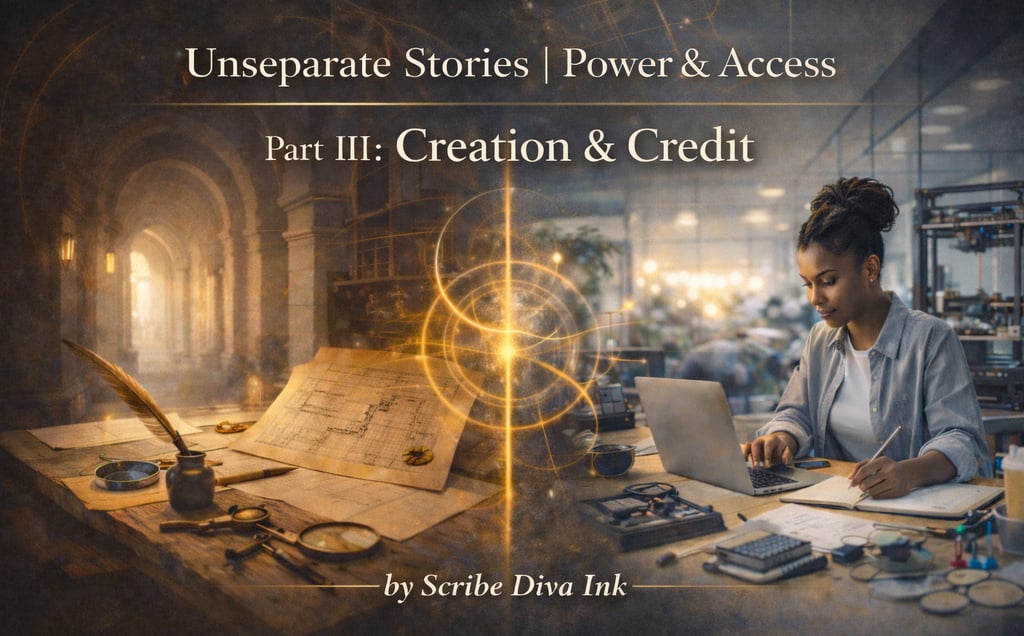
In metaphor, it is not only who builds the structure. It is whose name appears on the blueprint,
whose signature survives replication, and whose contribution is cited when the design is reused.
These conditions persist not solely through overt denial, but through systems that determine who understands the language of ownership, who has access to protection, and who can secure recognition before the work travels beyond them.
Credit shapes legacy the same way access shapes opportunity. What is signed is remembered. What is remembered becomes the foundation.

info@cjmarieholdings.com
© 2025 CJMarie Holdings, LLC. All rights reserved.
Join Us
Stay connected with insights and updates