UNSEPARATE STORIES | POWER & ACCESS – Part II: Voice & Visibility
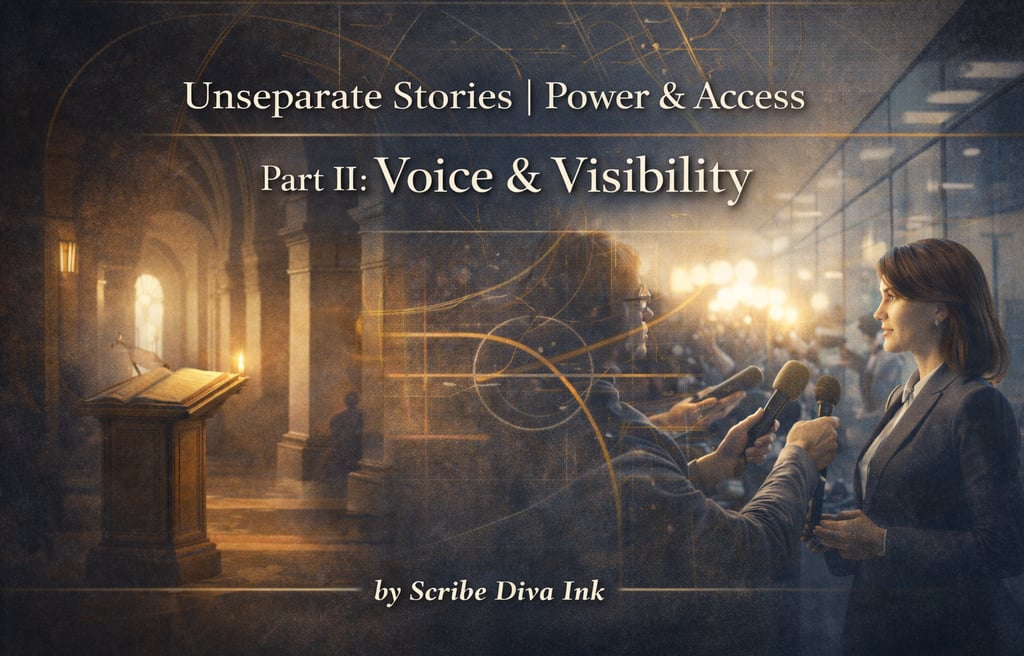
Voice and visibility are not the same as permission to exist. A person may enter a space and still remain unseen, may speak and still remain unheard. This is not always the result of silence or absence, but of uneven amplification, the subtle difference between being present and being acknowledged. Power and access influence not only who arrives, but whose presence carries weight once they do.
UNSEPARATE STORIES
by Scribe Diva Ink
3/9/20262 min read
UNSEPARATE STORIES | POWER & ACCESS –
Part II: Voice & Visibility
by Scribe Diva Ink
There are gates we can touch, and there are gates we can only feel. Some barriers are made of cost, paperwork, or distance. Others are made of volume, recognition, and introduction.
A person may enter the invited room and remain unheard. A name may exist intentionally and never be spoken.
Power and access do not only determine who arrives. They also determine who is noticed once they do.
This is not an article about silence as absence. It examines of how visibility and voice are distributed. The question is not who is allowed to speak. The question is whose speech carries weight, whose ideas travel, and whose presence is validated without repetition.
Control of Political Voice
Historically, political voice was not always denied outright. It was often conditioned through literacy tests, poll taxes, and procedural requirements that determined who could participate and whose participation counted. In the present day, the language has changed, yet the mechanics sometimes rhyme:
disparities in voter access and polling availability
district boundaries that shape representation
lobbying influence that outweighs individual voices
media amplification that prioritizes certain concerns over others
Power here is not solely about governance. It is about urgency. Whose issue is treated as urgent, and whose concern is delayed until it no longer expects a response.
A microphone may exist, but if its volume is adjusted unevenly, some voices echo while others dissipate.
Control of Information and Education
Knowledge is not only accumulation. It is orientation. The ability to understand the landscape one is standing in.
Historically, restrictions on literacy and schooling were explicit.
Access to books, classrooms, and formal instruction was limited by identity, gender, or status.
Today, limitation more often appears as unequal quality rather than outright denial. This can look like:
uneven school funding and resource allocation
digital divides that separate connectivity from isolation
algorithmic information silos that narrow perspective
misinformation ecosystems that distort clarity
Information does not need to be forbidden to be ineffective. If the map is incomplete or distorted, navigation falters. Education, in this sense, is not merely academic. It is the difference between recognizing a pathway and walking past it without knowing it was there.
Social Gatekeeping and Networks
Not all access is legal or financial. Much of it is relational.
Historically, aristocracies, caste systems, and closed guilds determined entry through lineage or sponsorship. Belonging preceded merit. In the present day, this pattern often appears less formally but no less powerfully:
professional networks shaped by culture or cost
unpaid internships accessible only to those who can afford time without income
alumni circles and legacy pipelines
invitation-only opportunities that rely on introduction rather than visibility
This is the dimension of access that rarely appears in policy documents. It exists in conversations, recommendations, and familiarity.
A door may not be locked, but it opens only to those who know the code.
The Underlying Mechanism
Oppression through power and access is seldom only about entry. It is also about amplification and legitimacy.
Who is introduced in the room?
Who receives recognition without repetition?
Who is believed the first time?
Who must restate their qualifications before being heard?
In metaphor, it is not only who boards the ship. It is:
whose signal is picked up clearly,
whose message is repeated over the speakers,
whose presence is announced before arrival,
and who must wave repeatedly to be seen.
These conditions persist not because they are always intentional, but because they are often normalized as “just the way things work.” Normalization reduces visibility, which in turn reduces correction.

info@cjmarieholdings.com
© 2025 CJMarie Holdings, LLC. All rights reserved.
Join Us
Stay connected with insights and updates