UNSEPARATE STORIES | Institutional Conditioning Part III: The Quiet Acceptance of Imbalance
This article explores how repetition reshapes perception over time. What once felt disruptive becomes familiar, and what becomes familiar is no longer interrupted. Acceptance often forms without agreement.
UNSEPARATE STORIES
by Scribe Diva Ink
5/18/20262 min read
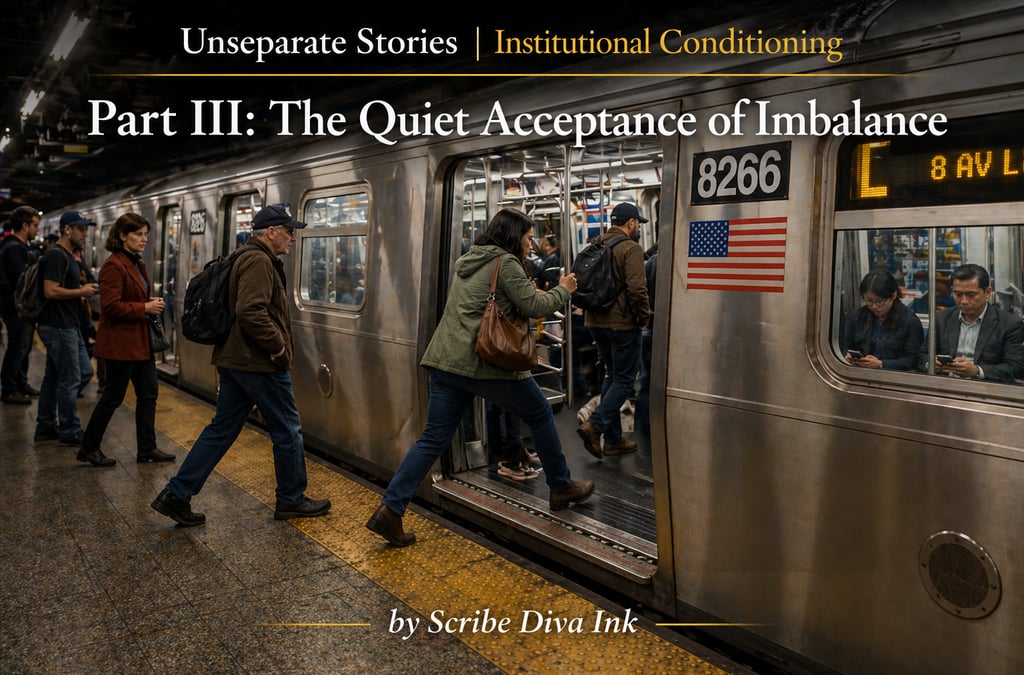

UNSEPARATE STORIES | Institutional Conditioning
Part III: The Quiet Acceptance of Imbalance
by Scribe Diva Ink
There are conditions that do not arrive all at once. They repeat. At first, they are noticeable. They interrupt expectation and draw attention. A response forms. There is recognition, then reaction. Over time, the interruption softens. What was once distinct begins to recur. What recurs becomes familiar, and what feels familiar no longer demands the same level of attention.
Dysfunction repeated becomes normal. Even outrage adjusts. This adjustment is not always deliberate. It does not require agreement or approval. It requires exposure. Repeated exposure alters perception. What once required explanation no longer does. What once felt out of place begins to align with expectation. The difference between what is and what should be becomes less defined, not because the distinction disappears, but because it is no longer held in the same way. Recognition remains. Reaction remains. Neither sustains interruption.
The Architecture of Imbalance
In public life, this pattern appears in ways that are both visible and subtle. Moments that once would have stopped movement are absorbed into it. Events that once demanded pause are processed and placed within an ongoing sequence. Attention forms, rises, and then recedes.
The killing of George Floyd in 2020 drew global attention. It was recorded, shared, and widely seen. Recognition was immediate, and reaction followed. There was international outrage. There were protests. There were calls for change. It was not the first. Incidents before it had already revealed the pattern, and incidents after it continue to do so. The names change. The details differ. The sequence remains.
Hurricane Harvey in 2017 brought catastrophic flooding to Texas. There was loss. There was displacement. There was national attention and response. Infrastructure was assessed. Systems were adjusted. Life moved on. It was not the last. It was not the first.
When Recognition Stops Interrupting
What is described as exceptional begins to appear with greater frequency. Language shifts. What was once unacceptable is reclassified, reframed, or contextualized. The threshold for concern adjusts. The threshold for interruption rises. What is anticipated is planned for, and what is planned for is no longer urgent.
Repeated exposure alters collective response. Attention shortens. Emotional intensity becomes difficult to sustain. Events that once produced shock become integrated into expectation. Awareness remains present, yet urgency weakens through recurrence.
This is not indifference. It is adaptation. Systems and individuals alike learn to continue functioning alongside instability. The extraordinary becomes manageable once it is experienced often enough. Recognition remains intact, but interruption fades.
Safe floors do not tilt. Yet over time, repeated imbalance can begin to feel navigable. People adjust their footing. They compensate instinctively. The body learns what the mind no longer actively questions.
The Underlying Mechanism
Institutional conditioning rarely depends on denial alone. It is reinforced through repetition, adaptation, and the gradual normalization of imbalance.
What happens when disruption becomes familiar?
At what point does repetition reduce urgency?
When does recognition stop producing interruption?
How often must imbalance repeat before it becomes expected?
In metaphor, it is not only whether the floor tilts. It is:
who notices the imbalance first,
who is told the shift is temporary,
who learns to walk despite instability,
and who eventually forgets the floor was meant to be level.
These conditions persist not always because people approve of them, but because repeated exposure reshapes expectation. Familiarity reduces alarm. Reduced alarm weakens interruption. What continues long enough begins to feel survivable.
This is the quiet acceptance of imbalance. Recognition remains present, yet adaptation softens resistance. The system continues not because instability disappears, but because people learn to move within it.
What repeats often enough no longer feels exceptional.

info@cjmarieholdings.com
© 2025 CJMarie Holdings, LLC. All rights reserved.
Join Us
Stay connected with insights and updates