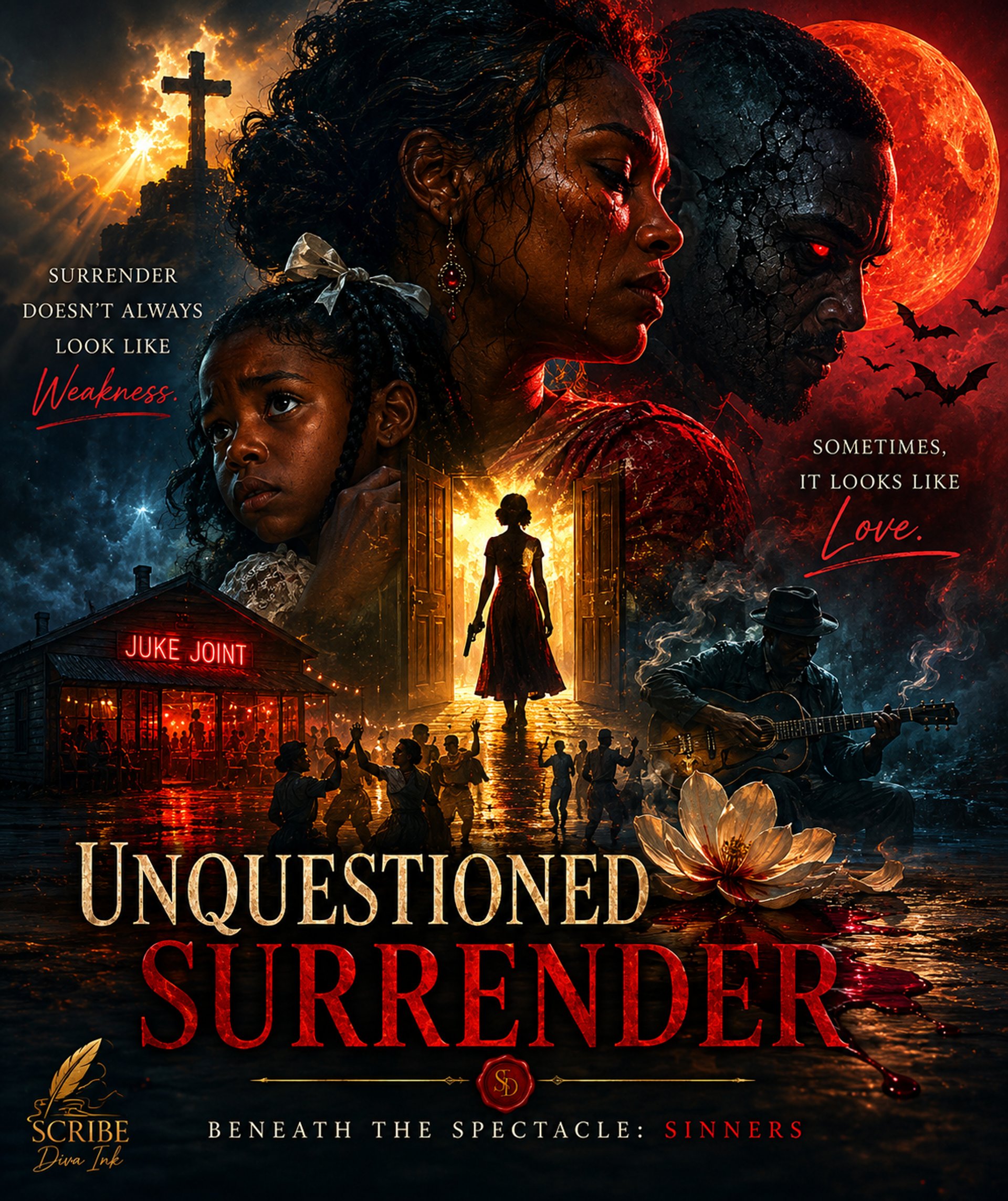
Unquestioned Surrender
SINNERS (MOVIE)
Scribe Diva Ink
6/15/20264 min read
UNQUESTIONED SURRENDER
©2026 Scribe Diva Ink
Throughout Sinners, yielding rarely arrives wearing the face of danger. More often, it emerges disguised as safety, salvation, certainty, love, guidance, relief, or communal refuge. Beneath the vampire mythology lies something far more psychologically and spiritually layered than supernatural horror alone. The vampires cannot simply enter. Entry must be permitted. That rule matters because permission implies acquiescence. Welcome must be extended.
Vampirism therefore evolves beyond physical attack into a symbolic examination of agency itself. Underneath the spectacle rests a deeper interrogation: what conditions lead human beings to relinquish authorship of self? Rarely does such relinquishment appear threatening at first. More often, it feels comforting. Fulfilling. Intimately familiar. That contradiction may be one of the story’s most unsettling revelations.
One of the film’s most provocative symbolic parallels emerges through the relationship between religious devotion and vampiric conversion. Both involve trust, welcome, altered identity, relational attachment, transfer of agency, and movement toward something larger than the individual self. This does not render the two equivalent, nor does the narrative appear interested in mocking spirituality itself. Yet the symbolic overlap feels deliberate enough to examine carefully. At what point does guidance shift into submission? When does collective safety begin requiring erosion of self-definition? At what point does salvation language become indistinguishable from absorption?
These questions gain further depth through Sammie’s relationship with his preacher father. The preacher embodies ancestral spiritual authority, inherited moral structure, prescribed pathways toward redemption, and cultural expectations rooted in tradition. Sammie, meanwhile, remains pulled toward expression, embodiment, artistic openness, inward vulnerability, and self-formation. The resulting friction is not merely rebellion versus obedience. It reflects an ongoing struggle between traditional structure and conscious self-authorship.
Underlying much of the story is a larger question regarding whether identity can fully emerge without resisting imposed narratives first.
That philosophical tension expands even further when considering bequeathed acquiescence itself. Many forms of social integration begin long before conscious adulthood. Children absorb rituals, loyalties, moral systems, traditions, spiritual frameworks, and cultural expectations before possessing the developmental capacity to meaningfully interrogate or reject them. This does not render inheritance inherently harmful. However, it does raise difficult questions regarding consent, self-definition, and conscious participation inside systems received and accepted before discernment fully develops.
Practices such as christening, baptism, or early spiritual dedication become symbolically significant within this framework because commitment often precedes conscious evaluation. Inclusion begins before questioning ability fully forms. Identity is frequently shaped long before it becomes consciously examined.
Within that context, the recurring emphasis on welcome acquires even greater philosophical weight. What does permission truly mean when social attachment begins before understanding? What does yielding signify when selfhood itself forms inside preexisting structures? Again and again, the narrative returns to the friction between imparted belonging and conscious agency.
The vampire entry rule reinforces this symbolically throughout the story. The creatures consistently require openness, vulnerability, emotional permeability, or invitation before crossing thresholds. Alteration requires participation. Vulnerability creates reachability. Again and again, danger enters through trust, familiarity, attraction, loneliness, longing, or the human desire for connection.
Mary’s entrance becomes especially significant through this lens. She gains entry not because she appears frightening, but because she feels recognizable. Familiar. Safe. The threat does not arrive disguised as hostility. It arrives wearing emotional intimacy. Perhaps that is one of the most unsettling insights: human beings are often most vulnerable to what already feels psychologically recognizable. The threshold becomes less about logic and more about relational accessibility.
Grace Chow introduces an entirely different form of yielding. Her vulnerability does not emerge through seduction, longing, desire for inclusion, or romantic temptation. Instead, it develops through desperation, parental fear, frustration, and protective instinct. After her daughter is threatened, her psychological state gradually collapses beneath unbearable pressure. Calling the vampires into the juke joint feels less like willing trust and more like exhausted confrontation under emotional duress. Yet the outcome remains unchanged. Entry is still granted.
Her storyline becomes especially tragic because it reflects one of humanity’s most recognizable instincts: parents sacrificing themselves for their children. Love itself functions as an opening. The narrative appears deeply aware that acquiescence does not always emerge from weakness. Sometimes it grows from devotion, fear, responsibility, desperation, or willingness to absorb harm on behalf of someone else.
A lingering question remains beneath Grace’s final actions: did she ultimately kill her husband to stop what he was turning into before that corruption reached their daughter? If so, her final act transforms into something more complicated than surrender alone. It becomes interruption. Protection through destruction. A desperate attempt to reclaim agency before the contagion could continue spreading through the family itself.
This possibility deepens the story’s recurring concerns surrounding alteration. Throughout Sinners, violence, spirituality, memory, relational closeness, and transformation move through proximity itself. Human beings become reachable through familiarity, lineage, trust, established structures, and emotional attachment.
The vampires themselves frame conversion through the language of togetherness, eternity, liberation, connection, and relief from suffering. They do not initially present themselves as isolation or destruction. Instead, they offer refuge. Community. Release from loneliness, limitation, uncertainty, and fear.
That framing profoundly complicates the idea of freedom. Several transformed characters genuinely appear convinced they have moved closer toward liberation. Yet their existence remains bound by conditions: no sunlight, collective consciousness, altered appetite, spiritual dependence, and separation from ordinary humanity. Beneath that contradiction lies another lingering question: can liberation still be called freedom when the self must be fundamentally reconstructed to sustain it?
That question stretches far beyond vampirism alone.
Rarely do people relinquish themselves all at once. More often, acquiescence unfolds gradually through familiarity, longing, inherited identity, trust, vulnerability, exhaustion, certainty-seeking, longing for connection, or hope that surrender might finally provide relief.
Perhaps that is what makes unquestioned surrender so dangerous.
It rarely arrives appearing dangerous at all.

info@cjmarieholdings.com
© 2025 CJMarie Holdings, LLC. All rights reserved.
Join Us
Stay connected with insights and updates