Trapped Inside and Inherited Narrative
SINNERS (MOVIE)
Scribe Diva Ink
6/22/20262 min read
Trapped Inside an Inherited Narrative
©2026 Scribe Diva Ink
Humans inherit stories before they inherit understanding.
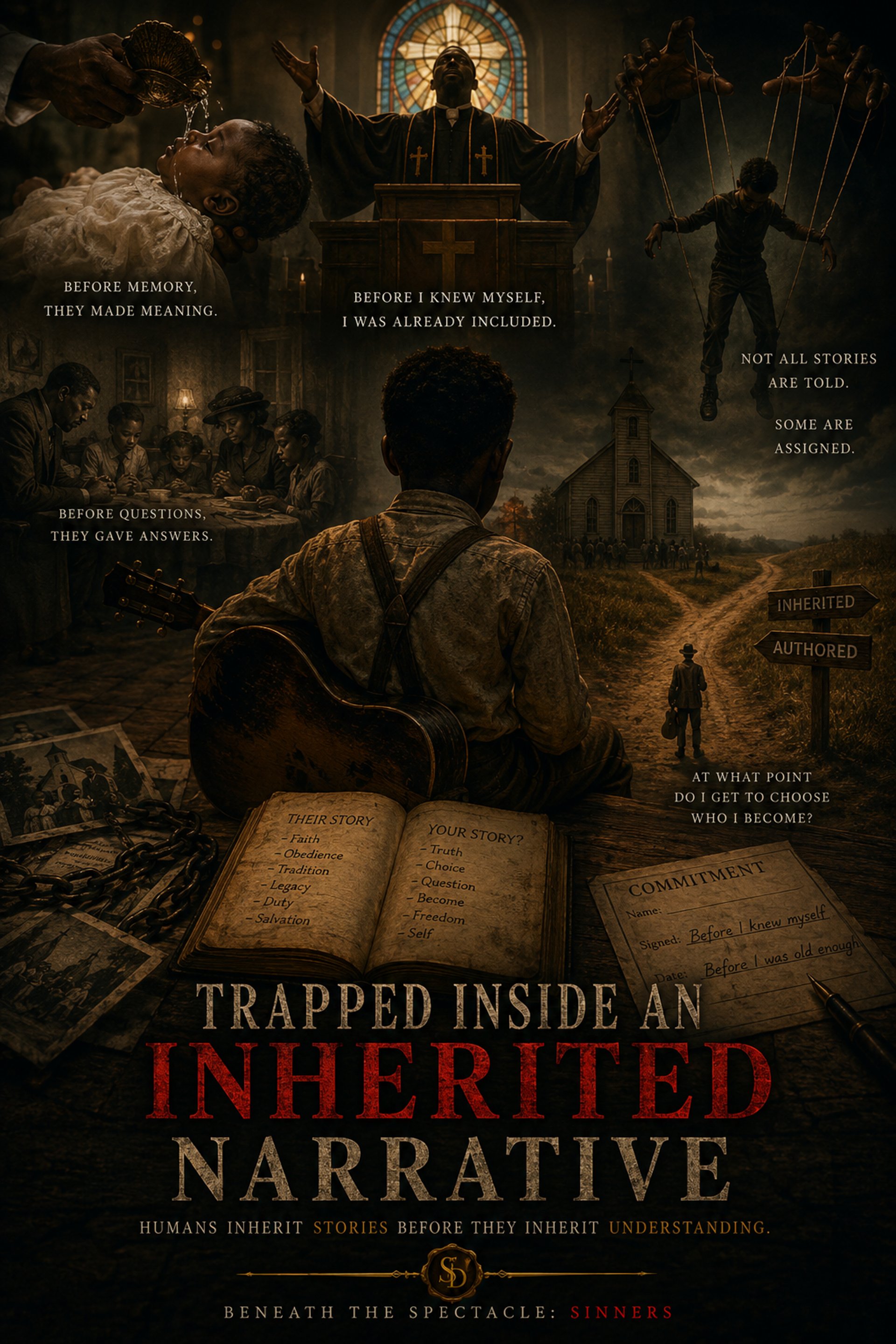
Long before most people fully identify themselves, they are already being shaped by guiding principles involving religion, morality, family structure, culture, gender expectations, spirituality, success, and belonging. Many people are entered into systems of meaning prior to possessing the developmental ability to consciously interrogate or meaningfully consent to them.
This does not automatically make inheritance harmful. Legacy is part of human continuity. However, customs become philosophically complicated when predefined identity clashes with newly forming self-awareness. This is one tension that quietly sits beneath much of Sinners.
The previous stresses surrounding surrender, invitation, belonging, and transformation deepen further when viewed through the lens of the inherited self. The film repeatedly suggests that people are programmed with stories about who they are and who they are supposed to become. That distinction matters.
Many individuals enter lifelong spiritual, ideological, cultural, and communal commitments before they vote, drink, fully understand themselves, or develop distinctiveness outside received systems. These commitments often feel natural precisely because they were ascribed prior to conscious discernment, having become second nature. Does that equate to meaningful consent?
Sammie’s relationship with his father becomes especially significant within this situation. The preacher does not simply represent religion. He represents established certainty, authority, morality, and pathways toward salvation and legitimacy. Sammie, however, repeatedly moves toward expression, embodiment, emotional openness, artistic becoming, and individual authorship.
The tension between them is not merely rebellion versus obedience. It is inherited identity confronting conscious self-definition.
Importantly, the film never presents this tension simplistically. Foundational structures often provide community, protection, continuity, meaning, guidance, and emotional stability. Yet those same systems may limit individuality before conscious examination fully develops. That complexity gives the film emotional and philosophical weight.
The symbolism surrounding Sammie’s guitar deepens this tension further. The evolving mythology surrounding the guitar repeatedly shifts throughout the film, raising questions. Objects, traditions, and stories often acquire meaning through repetition long before their origins are consciously examined. The guitar gradually becomes more than an instrument. It becomes symbolic inheritance. Legacy. Identity. Protection. Possibility.
The film repeatedly asks whether humans are presented with truth or historical interpretations of it.
This tension connects directly to the distinction between edited and scripted identity. Scripted suggests predetermination. Edited – ongoing revision. Sinners appears less interested in whether people inherit narratives and more interested in whether people realize they can consciously examine, revise, resist, or reauthor them.
That possibility changes everything.
Because many people never realize they are allowed to interrogate inherited selfhood at all.
The symbolic casting of Saul Williams as the preacher deepens this tension even further. Saul Williams carries strong cultural associations with poetry, intellectual resistance, spirituality, artistic consciousness, and philosophical rebellion. His presence introduces symbolic contradiction before his character even speaks. The casting itself quietly reinforces the tension between long-established authority and conscious awakening.
The film repeatedly returns to a larger question beneath the visible story: who would people become outside a life they never consciously chose?
That question extends far beyond religion alone. Humans are born into identities, perspectives, assumptions, aspirations, and definitions of worth long before most fully understand the structures shaping them. This does not mean all time-honored practices are false. It means they are powerful.
Perhaps that is why conscious self-authorship feels so destabilizing for many people. To question inherited narratives can feel like questioning family, belonging, morality, safety, continuity, spirituality, and community simultaneously. Awakening often carries emotional cost because conventional reasoning is rarely experienced as abstract ideas alone. It is emotionally embedded into identity itself.
Sinners never fully resolves these tensions. Instead, it allows the questions to remain active beneath the spectacle.
At what point do humans realize they are allowed to revise inherited identity?
And who might they become afterward?

info@cjmarieholdings.com
© 2025 CJMarie Holdings, LLC. All rights reserved.
Join Us
Stay connected with insights and updates