Music as Summons, Memory, and Sin
SINNERS (MOVIE)
Scribe Diva Ink
6/8/20262 min read
MUSIC AS SUMMONS, MEMORY, AND SIN
©2026 Scribe Diva Ink
From the opening moments of Sinners, music feels spiritually significant. Before the narrative fully unfolds, the audience enters the film through rhythm, atmosphere, and emotional resonance. The opening does more than establish mood. It prepares the viewer for a world where sound itself carries symbolic weight.
As the story progresses, music repeatedly functions as something larger than entertainment. It opens, connects, summons, exposes, transforms, and synchronizes. The movie treats its various melodies almost like ritualistic access. Not merely performance, but power.
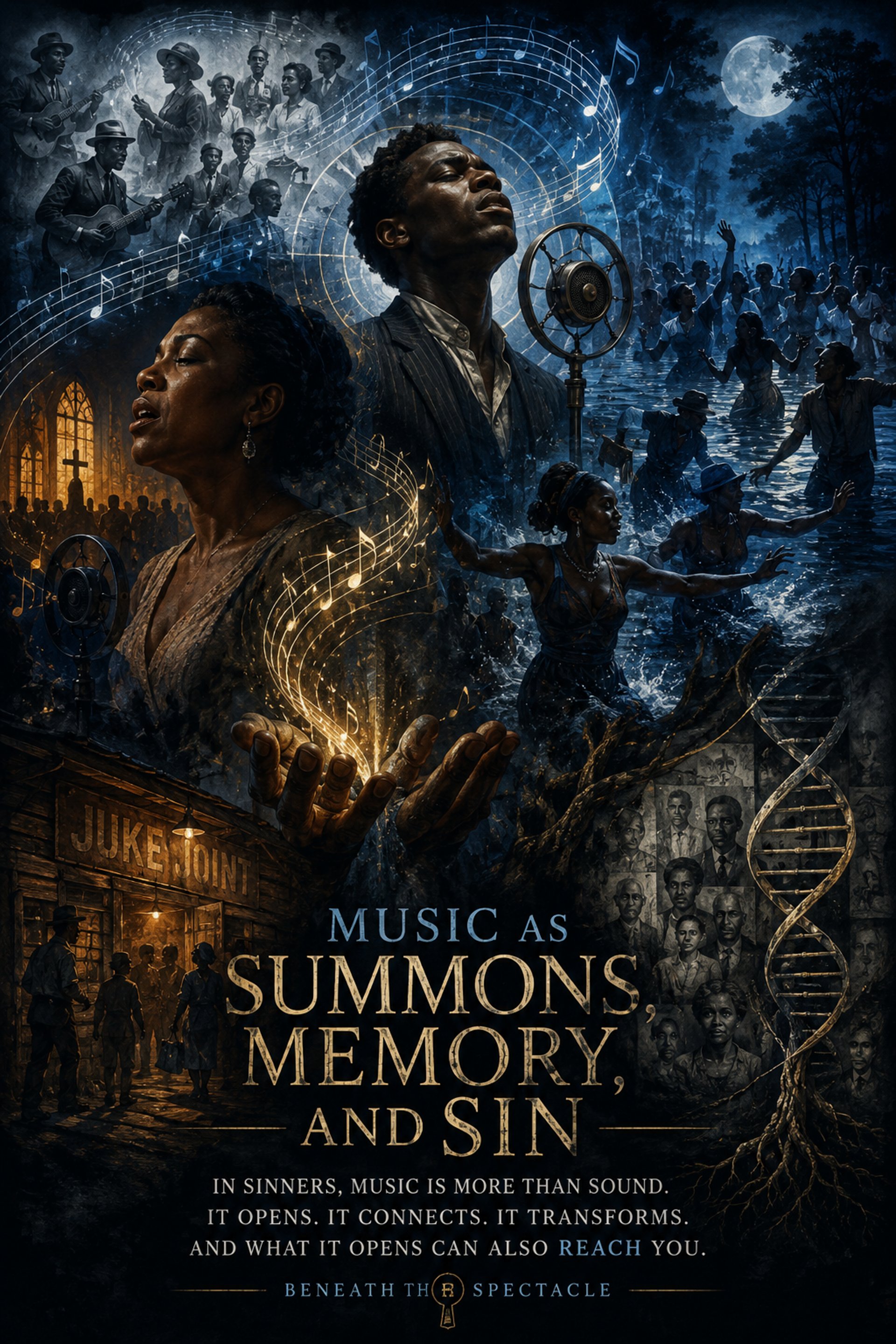
This becomes most visible through four pivotal musical movements: the opening melodic atmosphere, Sammie’s generational enactment, Pearline’s singing, and the vampires’ collective singing and river dance. Together, these moments progressively deepen the metaphorical relationship between expression, spirituality, surrender, transformation, vulnerability, and communal participation.
Sammie’s routine may be the clearest example of music functioning as spiritual access. During his performance, the film collapses generations of Black rhythmic language into a single moment. Past, present, and future appear to coexist through beat, embodiment, and sound. The sequence suggests that hymn carries memory. Not simply personal memory, but ancestral continuity itself.
The scene transforms music into something far larger than entertainment. It emerges as invocation. Transmission. Identity. Remembrance. Reach.
Importantly, Sammie’s gift is recognized almost immediately by the lead vampire. Before fully entering the community, he identifies Sammie specifically. Not merely because Sammie can sing, but because something about his music reaches beyond ordinary boundaries. The movie appears to suggest that true authenticity carries divine visibility. Something carried through lineage. The very thing connecting Sammie to ancestry, memory, culture, and identity may also make him visible.
That tension matters throughout the film.
Historically, this symbolic framework becomes even more layered when considering the relationship between Blues and Black church culture. Blues music was often morally contested within religious spaces, particularly during the Jim Crow era. Juke joints functioned as spaces of release, embodiment, emotional expression, music, drinking, dancing, gambling, and temporary escape beneath oppressive social realities. Church and blues frequently existed in symbolic tension with one another: salvation versus release, restraint versus embodiment, spiritual discipline versus passionate expression.
Sinners appears deeply aware of this historical tension.
What if the film is not simply asking whether music is good or dangerous, but whether emotional openness itself creates supernatural reachability?
That question becomes even more visible through Pearline’s singing. Unlike Sammie’s expansive generational sequence, Pearline’s performance feels intimate, arousing, and embodied. The scene carries longing, vulnerability, release, and spiritual exposure. Music here functions as converging transformation. Not a passive act, but embodied revelation.
The progression reaches its most unsettling form through the vampires’ singing and river dance. By this point, music no longer functions primarily as individual expression. It becomes communal synchronization. Bodies move together rhythmically. Individuality weakens as synchronized movement overtakes the self. The sequence feels ritualistic, ecstatic, almost mystically absorptive.
This creates one of the film’s most significant tensions: the same mechanisms capable of creating connection, transcendence, emotional release, and communal belonging may also create vulnerability.
Music lowers barriers. Rhythm synchronizes bodies. Collective involvement dissolves distance between individuals. It is repeatedly suggested that openness itself can become invitation.
This deepens the recurring themes of participation, surrender, and reachability throughout the story. Music echoes both liberation and exposure. The same force capable of connecting generations and releasing honest truth may also create susceptibility to conversion.
This may explain why the film repeatedly links music, movement, dance, embodiment, and spiritual openness together. Dance itself epitomizes involvement. Movement becomes surrender through rhythm. The body stops merely observing and begins joining.
At what point does communion become transformation? At what point does collective connection become absorption into something larger than the self? Sinners never fully resolves these questions. Instead, it allows the tension to remain active beneath the spectacle.
Perhaps that is the point. The film does not present music as neutral. It presents it as power.

info@cjmarieholdings.com
© 2025 CJMarie Holdings, LLC. All rights reserved.
Join Us
Stay connected with insights and updates