Merit Redefined | When the Rules Change After You Win
I had planned to publish the next article in my Unseparate Stories series this week but sometimes a thought refuses to wait. So, I’m pausing the series until next Monday to share a timely reflection that has been sitting with me. What happens when people follow the rules, invest years meeting the standard, and then the standard changes? This reflection explores that pattern. Merit Redefined | When the Rules Change After You Win.
Scribe Diva Ink
3/23/20263 min read
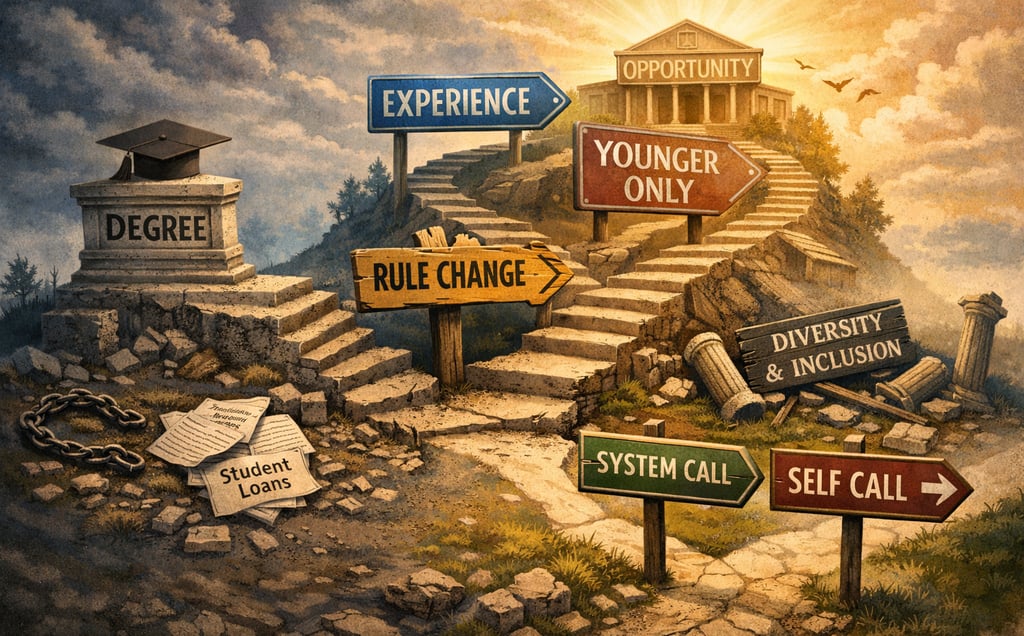
For years the instruction was simple. Get the degree. Education was presented as the great equalizer, the pathway to stability, respectability, and economic mobility. If you wanted access to professional work, you needed the credential. So people followed the instruction.
People studied and borrowed money. They delayed other parts of their lives. Entire families invested in the promise that education was the key. Black women responded to that instruction in particular ways. For decades they were told they were not qualified without the credential, so they earned it. They became one of the most educated groups in the country, often balancing work, family, and school at the same time. They did exactly what society told them to do.
Then something interesting happened. The requirement changed.
Suddenly companies began saying degrees do not matter. Skills matter. Experience matters. What was once the ticket into the room was now described as unnecessary. And just as that standard faded, new ones appeared. Industry background. Cultural fit. Age. The rule moved.
This pattern is not new. First a rule defines who is allowed in. Then people pay the price to meet that rule. Then the rule changes. Rule established. Cost paid. Rule rewritten. The rule moves forward, but the price people paid does not.
We have seen this pattern before. The figure skater Surya Bonaly performed one of the most difficult moves in skating, a backflip landing on one blade. It was spectacular and innovative, yet it was also prohibited in competition. She was penalized for doing it, and her career carried the consequences of a rule that defined what was acceptable at the time. Years later the sport evolved. The rule changed. Her lost opportunities did not return.
We see the same structure in law. For years alcohol production during Prohibition and marijuana possession carried serious criminal penalties in many places. Thousands of people served long sentences under those laws. Now alcohol is legal and marijuana has been decriminalized or legalized in many states. Again, the rule changed. But the people who served the time or lost their lives do not get those years back.
We see the same structure unfolding in the workplace. For years the instruction was clear. Get the degree. So people did. Universities expanded. Tuition increased. Entire industries formed around helping people obtain the credential that was now required for professional work.
Then the message shifted. Degrees no longer matter. Then another shift appears. Experience is too expensive. We want younger talent. Then another shift. Entire departments disappear. Diversity, equity, and inclusion programs are dismantled. Once again, the rule moved. At some point a difficult observation begins to surface. If the rules keep changing after people meet them, were the rules ever the real point?
When the standard changes every time someone meets it, people begin to see the structure behind it. Once the structure becomes visible, the conversation changes. The issue is no longer whether individuals are qualified. The issue becomes how merit itself is defined and redefined.
Across many parts of society, the pattern repeats. People pay the cost to meet an established rule. Then the rule changes and systems move forward as if nothing happened. But the people who paid the original price remain where the rule left them. Student loan debt. Lost careers. Entire professions disappearing overnight. Lost time.
This creates another dilemma. How does someone make life decisions when the definition of merit keeps changing?
Many people make what I call a system call. A system call means shaping your life around the standards institutions claim will lead to opportunity. Get the degree. Build the resume. Follow the path the system says is necessary to land the job you want. For decades many people did exactly that. But when institutions redefine merit after those sacrifices are made, people begin to reconsider how decisions should be made in the first place.
Some begin making what I call a self call. A self call means making decisions based on personal judgment rather than constantly adapting to shifting institutional standards. Choosing work that aligns with your abilities and interests, defining success on your own terms, and building a life that is not entirely dependent on a system whose rules may change tomorrow.
This is not simply a question about employment or education. It is a question about how people build their lives. When the rules remain stable, people can plan accordingly. But when merit keeps being redefined, the calculation changes.
People begin asking a question that institutions rarely answer directly. If the criteria keep changing, were the criteria ever the real point? Or were they simply the language used to explain who gets access and who does not? Merit, it turns out, is not always a fixed standard. Sometimes it is a moving one. And when merit keeps moving, the people who followed the rules start to notice something.
The rules seem to change most often after they finally win.
Of course, who is actually winning depends on where you stand.

info@cjmarieholdings.com
© 2025 CJMarie Holdings, LLC. All rights reserved.
Join Us
Stay connected with insights and updates