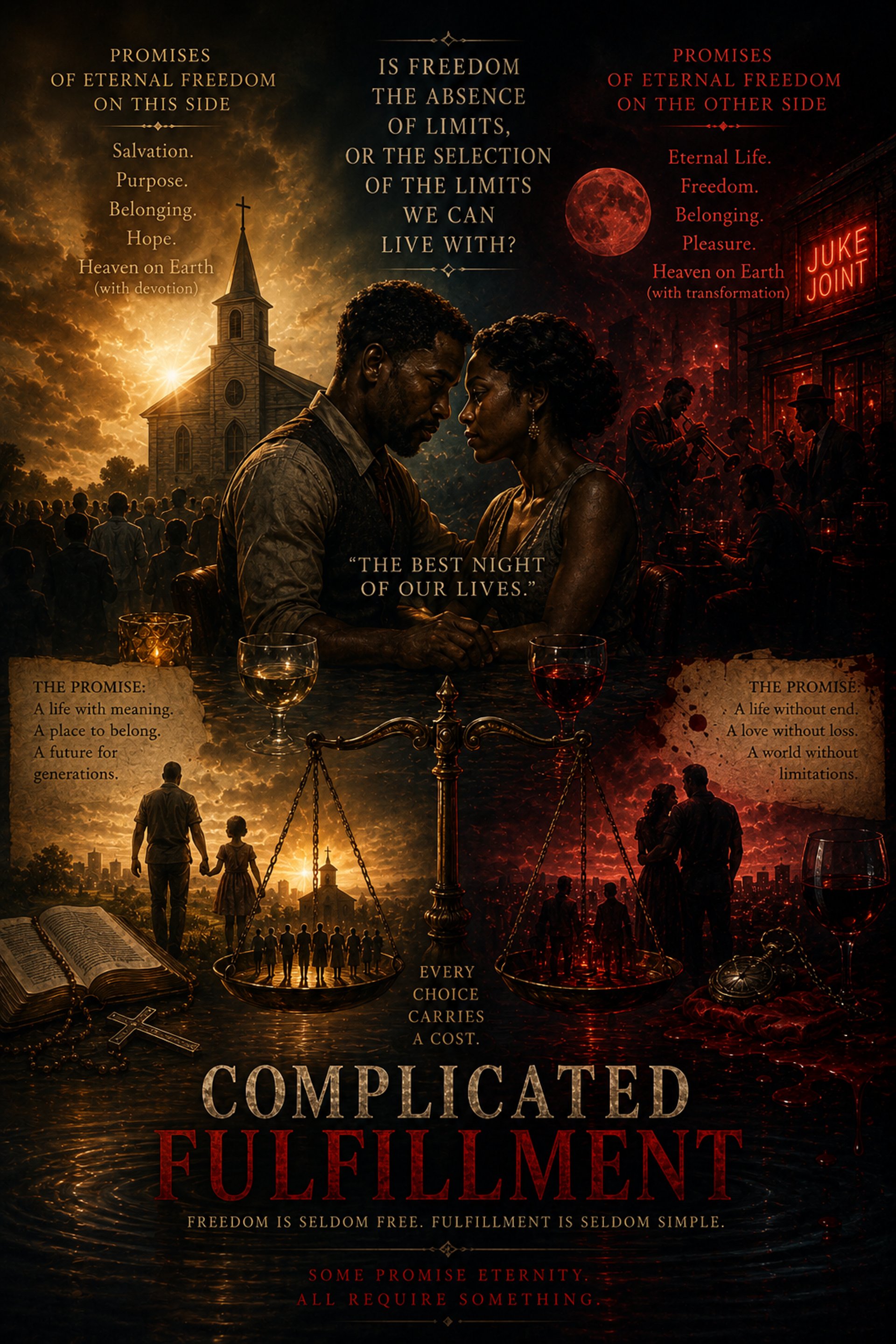
Complicated Fulfillment
SINNERS (MOVIE)
Scribe Diva Ink
6/29/20262 min read
COMPLICATED FULFILLMENT
©2026 Scribe Diva Ink
One of the most unsettling aspects of Sinners is that the film never fully presents transformation as absolute ruin. That matters. If the transformed characters appeared entirely empty, monstrous, or emotionally destroyed, the film's moral tension would become simplistic. Instead, Sinners repeatedly presents fulfillment as sensitively real, even when it exists under unwanted conditions.
Stack and Mary may be the clearest example of this tension. By the film's conclusion, they are still together. Still connected. Still intensely bonded. Their affection does not appear performative. Their certainty does not appear entirely false. Their existence has clearly changed, yet they still speak about love, belonging, freedom, and contentment as though those things remain meaningful to them. Their liberty carries undeniable limitations. They cannot walk in sunlight. They exist in exile from ordinary life. Their identities, appetites, and existence itself have been fundamentally altered. Their liberation required transformation. Their transformation required surrender. Yet the film never fully dismisses their realized fulfillment as fake.
That complexity adds additional philosophical weight. Throughout human history, promises of autonomy have rarely existed without conditions. Religious systems promise salvation, transcendence, eternal life, spiritual peace, and moral belonging, often through forms of discipline, devotion, structure, sacrifice, or obedience. Societies promise sovereignty through law, identity, citizenship, labor, achievement, conformity, and participation inside collective systems. Relationships promise intimacy, love, stability, and companionship while simultaneously requiring compromise, vulnerability, responsibility, and limitation. Even individuality and eventuality carry conditions. To become fully oneself often requires isolation from certain forms of belonging, misunderstanding from others, emotional risk, uncertainty, and separation from inherited expectations.
Sinners quietly places vampiric transformation inside this broader human tension. The vampires repeatedly frame transformation through the language of eternity, liberation, connection, and belonging. They promise independence from loneliness, suffering, limitation, fear, and death itself. Yet their version of self-governance still requires adaptation to a new structure of existence. Freedom remains conditional.
That may be one of the film's most uncomfortable revelations: many forms of attainment are negotiated rather than absolute. People often exchange one set of limitations for another set that feels more survivable. The film appears deeply interested in whether human beings truly seek unlimited individualism at all. Absolute self-rule may sound liberating conceptually, yet human life itself constantly operates through negotiation: belonging with compromise, love with vulnerability, identity with responsibility, community with expectation, security with limitation, and transcendence with surrender.
Even the promise of "heaven on earth" within the film carries conditions beneath its seduction. The language surrounding eternal fulfillment repeatedly sounds emotionally appealing precisely because it offers relief from human suffering, isolation, uncertainty, and mortality. Yet the cost of that relief remains present underneath the promise itself and asks: Is freedom the absence of limits, or the selection of the limits we can live with?
Again, the film never answers the question directly. It simply asks viewers to sit inside the discomfort of it. The truth is more emotionally complicated than people prefer to admit. Many individuals already live inside negotiated forms of fulfillment. People remain inside systems, relationships, identities, careers, ideologies, religions, and communal structures that simultaneously nourish and restrict them. Human beings often accept certain limitations willingly because the alternative may feel lonelier, more unstable, more uncertain, or more costly.
This does not necessarily make those choices false. But it does make them multidimensional. That may explain why Stack and Mary linger long after the film ends. They do not fit neatly into either liberation or imprisonment. Their existence embodies the compromise itself. They have lost something. They have gained something. The audience is left wrestling with whether those exchanges were tragic, understandable, seductive, survivable, or perhaps simply human.
Sinners refuses to reduce freedom into simplistic binaries. Instead, it quietly asks whether every form of fulfillment eventually reveals its conditions, and whether human beings are ever truly free from

info@cjmarieholdings.com
© 2025 CJMarie Holdings, LLC. All rights reserved.
Join Us
Stay connected with insights and updates