Unseparate Stories | Identity & Human Worth Part IV: Homogeneity and Conditional Belonging
This article examines how belonging is shaped in ordinary life. Not through formal exclusion, but through expectations that remain unspoken and widely understood. Because inclusion is often offered, but acceptance is rarely unconditional.
UNSEPARATE STORIES
Scribe Diva Ink
4/27/20263 min read
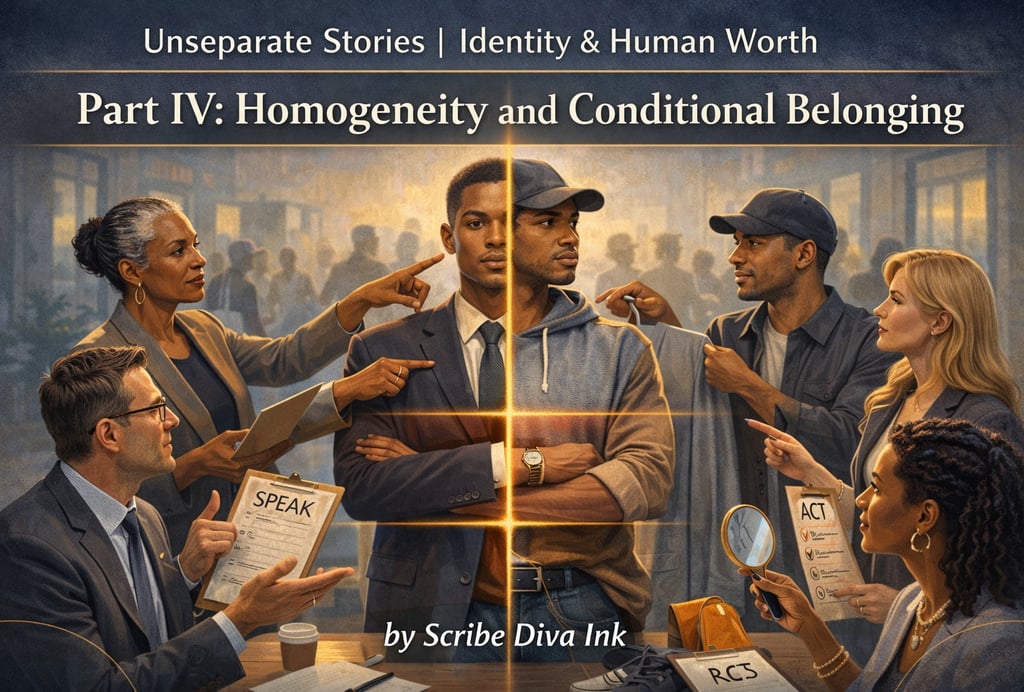

Unseparate Stories | Identity & Human Worth
Part IV: Homogeneity and Conditional Belonging
by Scribe Diva Ink
Human worth becomes visible in crisis, but social acceptance is tested in ordinary life. Inclusion is often described as open and generous, yet participation frequently carries conditions that remain unspoken but widely understood.
Acknowledgment is rarely unconditional. Recognition is often granted only when individuals present themselves in ways that feel familiar to others.
Those who live outside dominant norms are often expected to express themselves within recognizable parameters. Movement beyond those limits can invite correction or subtle exclusion. These responses do not always appear harsh. They often arrive as advice, humor, or gentle suggestion. Yet the effect is unmistakable. Personhood becomes something that must be demonstrated properly in order to remain secure.
Conditions of Belonging
Language provides one of the clearest illustrations. Speech patterns are frequently treated as markers of authenticity or deficiency. A person may be criticized for using too much slang or for using too little. The same verbal skill that allows movement across environments may be admired in one setting and treated as disloyalty in another.
Fluency becomes betrayal depending on who is listening.
Even shared knowledge can become a test of membership. Joking references to a revoked “Black card” reflect a deeper assumption that group membership can be evaluated and withdrawn. Familiar experiences, expected interests, and shared references become informal credentials. Participation becomes proof of legitimacy.
Identity becomes a passport that others feel authorized to revoke.
These assumptions operate both from outside and from within. Social boundaries are not enforced solely by outsiders. Communities themselves often maintain their own codes of acceptance. Individuals who move differently, speak differently, or choose differently may be perceived as drifting away even when no departure is intended.
Advancement can be interpreted as separation. Intellectual curiosity may be mistaken for cultural disloyalty. Educational attainment or professional success may be treated as evidence of disconnection rather than expressions of individual development.
Achievement is sometimes treated as evidence of disconnection.
When Authenticity Disrupts Comfort
Conditional endorsement also appears through the language of exception. Individuals are sometimes praised in ways that distinguish them from others who share their background. Statements describing someone as unusually articulate, attractive, or respectable often sound complimentary while quietly reinforcing separation. Individual approval is extended alongside implied criticism of the larger group.
These experiences often appear minor in isolation. A name may be shortened or replaced because it is considered easier to pronounce. A personal conviction may be treated as acceptable only when it remains private. Personal expression may be welcomed only when it remains familiar and non-disruptive. Each request may appear small, yet repeated adjustments accumulate into codes of conduct.
Norms extend across many forms of human difference. Ethnic background, religious conviction, gender expression, and personal values may all be subject to similar forms of evaluation. Individuals may be encouraged to soften or conceal aspects of themselves in order to maintain comfort around others. Approval may depend less on authenticity than on visibility.
Authenticity is often praised until it becomes inconvenient.
Social standing is rarely left entirely alone. Standards remain present even when they are not explicitly stated. Individuals learn to navigate these principles through small calibrations that allow movement through different environments while preserving connection.
The Underlying Mechanism
Oppression through conditional belonging is rarely sustained through direct exclusion alone. It is reinforced through familiarity, social calibration, and the quiet enforcement of acceptable identity.
Who is allowed to exist without adjustment?
Who must remain recognizable in order to remain accepted?
Who receives belonging without performance?
Who learns to negotiate acceptance through self-modification?
In metaphor, it is not only who enters the space. It is:
who is asked to soften before entering,
whose differences are tolerated only within limits,
whose authenticity becomes negotiable,
and who learns to translate themselves for comfort and approval.
These conditions persist not always through explicit rejection, but through normalized expectations surrounding acceptability and familiarity. Social correction becomes subtle. Subtle correction becomes habit. Habit quietly shapes belonging.
Acceptance often appears open until authenticity disrupts expectation. Inclusion may invite participation while still requiring calibration.
Identity and human worth are not only shaped by whether someone is allowed into the room. They are shaped by the conditions attached to remaining there.
Admission often comes with instructions.

info@cjmarieholdings.com
© 2025 CJMarie Holdings, LLC. All rights reserved.
Join Us
Stay connected with insights and updates