Unseparate Stories | Identity & Human Worth Part III: Whose Pain Counts
This article turns to a different measure of human worth—suffering. Not the experience of pain alone, but how that pain is interpreted, responded to, and prioritized. Because in moments of crisis, empathy, urgency, and protection are not always distributed evenly.
UNSEPARATE STORIES
Scribe Diva Ink
4/20/20263 min read
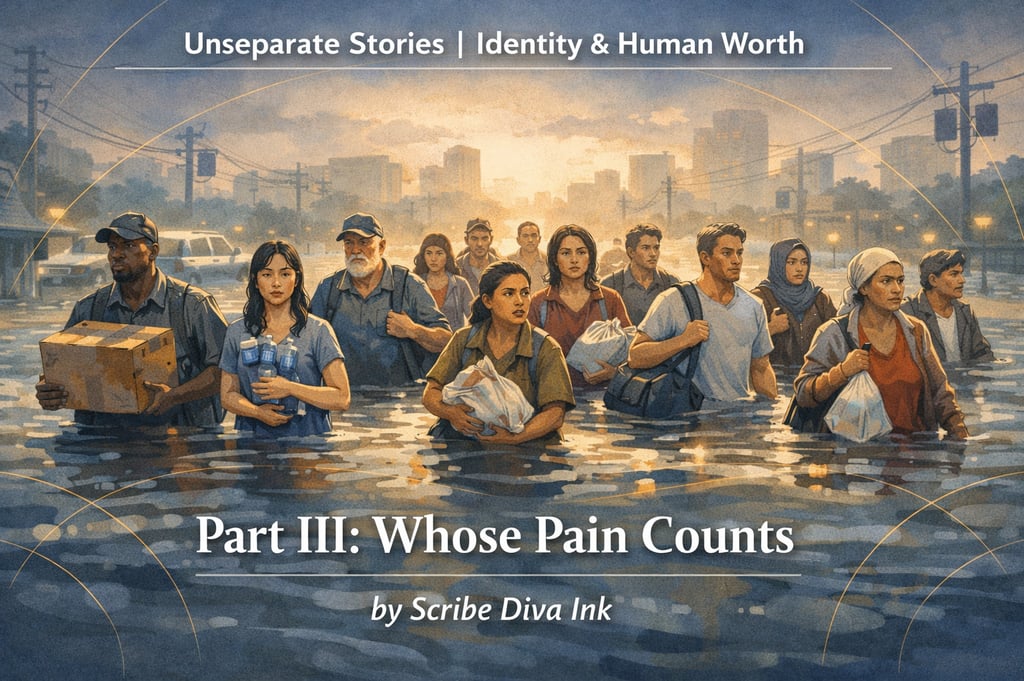
Unseparate Stories | Identity & Human Worth
Part III: Whose Pain Counts
by Scribe Diva Ink
Human worth becomes most visible in moments of suffering. Crisis reveals how human worth is measured.
Pain is not only experienced. It is interpreted. The response to suffering often reveals assumptions that remain less visible in ordinary circumstances. Unequal empathy, unequal urgency, and unequal protection do not always announce themselves openly, yet they become unmistakable when harm occurs.
Some suffering alarms the nation. Other suffering is absorbed quietly.
When Pain Requires Proof
Medical history provides clear examples of how pain has been interpreted unevenly. Black women were subjected to surgical procedures without anesthesia under the assumption that their bodies could tolerate greater suffering. Their pain was treated as manageable rather than urgent, observable rather than intolerable. The body became a site of experimentation rather than care.
When pain is discounted, humanity is discounted.
Medical experimentation revealed a similar pattern in the syphilis experiments in which Black men were promised treatment but instead observed as their illness progressed. Trust was extended and then exploited. Bodies were treated as instruments for study rather than lives requiring intervention.
Treatment was promised. Observation was delivered.
These histories illustrate more than individual wrongdoing. They reveal how suffering can be interpreted differently depending on who experiences it. Pain that requires proof is pain that is doubted. Some suffering is believed immediately. Other suffering must be documented repeatedly before recognition is granted.
How Crisis Reveals Value
Crisis makes these differences visible in ways that ordinary life does not. Public emergencies often reveal whose suffering is interpreted with sympathy and whose suffering is interpreted with suspicion. When Hurricane Katrina struck the Gulf Coast, images of residents searching for food and supplies circulated widely. The behavior itself was consistent across communities, yet the language used to describe it differed. Black residents were often described as looters, while white residents were described as survivors.
Behavior did not change. Labels did.
Interpretation shaped public response. Sympathy and suspicion do not produce the same urgency. Some victims are comforted. Others are investigated. Suffering does not guarantee empathy.
Urgency reflects priority. Delay reveals whose suffering is normalized.
Crisis continues to demonstrate how quickly empathy can mobilize and how unevenly that mobilization can occur. When tragedy strikes in highly visible settings, national attention often gathers immediately. Names are learned. Stories are told. Lives are recognized individually. Public grief becomes shared grief.
Other forms of suffering unfold more quietly. Harm accumulates over time or within communities that attract less sustained attention. Recognition may arrive slowly or not at all. The difference in response does not always reflect the severity of loss. It often reflects whose loss is seen as familiar, relatable, or deserving of immediate concern.
Protection does not arrive everywhere at the same speed.
These differences shape collective memory as well as immediate response. History influences trust even when events are no longer recent. Distrust did not appear without history. It developed through repeated experiences in which suffering was discounted or ignored.
The Underlying Mechanism
Oppression through unequal empathy is rarely sustained through open declaration alone. It is reinforced through interpretation, urgency, and the uneven distribution of concern.
Whose pain is believed immediately?
Whose suffering requires repeated proof?
Who receives protection without resistance?
Whose crisis is interpreted through suspicion before compassion?
In metaphor, it is not only who is injured. It is:
whose pain stops the room,
whose suffering mobilizes response,
whose grief becomes public grief,
and whose harm is absorbed quietly into the background.
These conditions persist not always through explicit rejection, but through normalized patterns of attention and emotional prioritization. Empathy becomes unevenly distributed. Uneven response becomes expectation. Expectation quietly shapes protection.
Human worth becomes visible when crisis arrives, and the response to suffering reveals how value is interpreted within a society. The same harm may produce different levels of concern depending on who experiences it.
Pain is not only a physical experience. It is also a social signal, interpreted through assumptions about credibility, belonging, and importance. Some suffering produces alarm. Other suffering produces endurance.
Crisis response reveals how human worth is measured.

info@cjmarieholdings.com
© 2025 CJMarie Holdings, LLC. All rights reserved.
Join Us
Stay connected with insights and updates