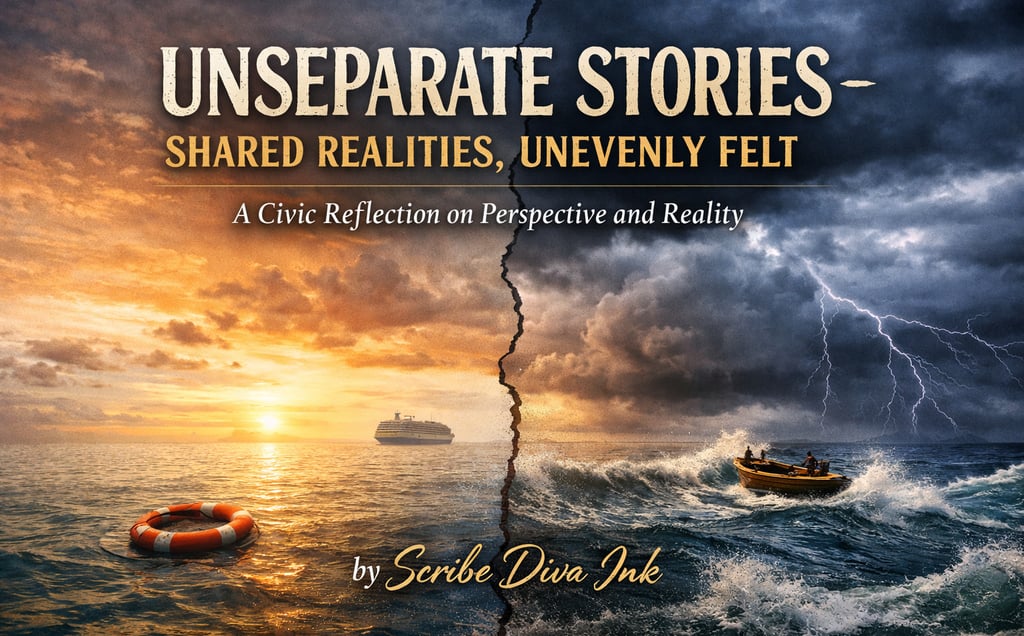
Unseparate Stories – Shared Realities, Unevenly Felt | A Civic Reflection on Perspective and Reality
This reflection begins a series exploring how we experience the same world through different vantage points. It is not an argument, nor is it an accusation. It is an invitation to pause and consider how position, proximity, and perception shape what we notice — and what we overlook. While our lived experiences are not identical, the conditions influencing them often overlap in ways we do not immediately recognize. This piece uses simple metaphors and shared observations to examine how awareness shifts depending on where we stand, and how clarity sometimes arrives only after impact. The goal is not to assign blame or demand agreement. The goal is reflection. Because when we understand that perspective can change while reality remains, we become better equipped to see more clearly, respond more thoughtfully, and engage one another with greater awareness.
UNSEPARATE STORIES
Scribe Diva Ink
2/7/20263 min read
This month is Black History Month. That matters. But if we are going to honor Black history honestly, we cannot do it only by looking backward. We have to be willing to honor the present, especially when the present echoes the past in ways that are uncomfortable to acknowledge. History is not just what happened. History is what keeps happening when the lesson is not learned.
In recent weeks, the deaths of civilians at the hands of law enforcement and federal authorities have once again entered the national consciousness. For some, these moments feel shocking. For others, they feel devastatingly familiar. That difference in reaction is not accidental. It is not moral failure. It is proximity.
Some people do not notice a thing until it affects them. That is a fact of human life. Awareness often follows impact, not principle. The problem is not that awareness arrives late. The problem is when late awareness demands silence about what came before.
If we want to move forward together, we cannot ask people to “mind our business” while ignoring the history that made that business urgent in the first place. Moving on without acknowledgment does not create peace. It creates repetition.
And repetition is how history becomes harm.
Remembering Is Not the Same as Reckoning
America has no shortage of remembrance. We light candles. We mark anniversaries. We say names. But candles without clarity are not honor. Anniversaries without analysis are not prevention. It is not enough to remember that people died. We have to be willing to remember how they died. Who killed them. Why it was justified. What failed to stop it. What was promised afterward. What actually changed. And whether those changes reduced harm or simply allowed us to move on.
This is not about staying stuck in grief. It is about refusing to confuse grief with learning.
Forgetting is leaving the conditions intact. When remembrance stops at mourning, the systems that produced the harm remain untouched. When the lesson is skipped, the pattern repeats, with new names, new dates, and the same explanations.
That is not just inevitability. That is also neglect.
A Pattern We Pretend Not to See
Over the last decade, the United States has witnessed a steady procession of deaths at the hands of those authorized to enforce the law. There was outrage. There were protests. There was global attention. And then there was quiet. Not because people did not care. But because many people were not yet wet. When you are standing on the upper deck, the boat can feel stable. The storm can feel exaggerated. The danger can feel theoretical.
Perspective changes with position. But physics does not.
The water does not disappear because some people are not touching it yet. And it does not become real only when it reaches new feet. This is not a story about blame. It is a story about structure.
What It Means to Honor the Dead
We often say we honor the deceased by remembering them. But remembrance alone is not enough. We honor them by refusing to let their deaths be instructional failures. That includes the recently deceased. It includes those whose names became movements. It includes those whose names never made the news. And it includes our ancestors, across generations, who lived and died under conditions that were normalized instead of repaired. Honoring them means asking not only what happened, but what we did with the knowledge afterward.
Did we change practices or just language? Did we redesign safeguards or just issue statements? Did we reduce harm or did we absorb it and move on?
These are not questions of ideology. They are questions of usefulness.
Leading With Love Without Forgetting
The language of “leading with love” is everywhere right now. That is not a bad thing. But love that avoids truth is not love. It is comfort. Remembering matters. But remembrance that stops at grief leaves the conditions unchanged. Refusing to normalize forgetting means asking what happened, why it happened, what failed to stop it, and whether what followed actually reduced harm or simply allowed us to move on.
Love, if it is real, demands more than sentiment. It demands memory with discipline. It demands clarity without cruelty. It demands accountability that does not discard compassion. And it demands that we stop pretending these are separate stories.
This upcoming series of articles for black history month was inspired by that realization. Not separate histories. Not separate realities. Unseparate stories. Shared conditions. Unevenly felt. We are in the same boat. Some of us have been wet longer. Some of us are just noticing the water.
The question is not who deserves a life vest. The question is whether we are willing to fix what keeps letting the water in.

info@cjmarieholdings.com
© 2025 CJMarie Holdings, LLC. All rights reserved.
Join Us
Stay connected with insights and updates